Sunday, April 5, 2009

Well that didn't take long


It's been two hours since the previous picture and it rained for about an hour during that time. Here's the hole now.


It looks as though there will be enough water running this way to make a pretty decent pond. It has already overflowed the original level on the downhill side. When the water goes down I'll work on it some more.

Notice how much clay is in the soil there. It may take a few days for the water to seep into the ground.

The slope of the hill can be seen on the far side of the pond compared with the level water. It's not steep, but a lot of area drains through this spot from the highway on down. By expanding the pond and the diverting swales a very large amount of water can be captured here. This can help a lot with watering the fruit trees since our emerging orchard is at least fifty yards from any other water source.

Holes


Over the last week a lot of holes were made. The easiest two were for two bluebird boxes. These are attached to 1/2" electric conduit pipe. The pipe was pounded into the ground with about 6' sticking out. The boxes are mounted as high as possible on these without being too high to open and clean out. This should keep squirrels, raccoons and snakes out of them. Both are oriented so they can be seen from the apartment windows. One can be seen in the first picture below.

On Friday night we went to the weekly auction at Dinkys. I picked up five more apple trees to go with the three from the FFA auction the previous week end. Each of the eight trees is a different variety. Let's hope they each have at least one tree to pollinate them.


We have piled dead rose bush trimmings and cut off grape vines around most of the trees. Soon they will all have their own deer-deterrent brush piles. These will be maintained until the trees are tall enough, and have enough leafing branches, that a few deer munchings won't be a catastrophe.

While I was moving soil from the large pile the county left me to the apple trees I noticed that there was a very large wet area below the driveway. Water was actually seeping from the ground, and it's been more than 2 days since it has rained.

Well if there's that much water running down the hill, thinks I, why not try to catch some of it above the apple trees? So I started digging a depression. I'm not calling it a pond yet, because I may quit digging at any time. It's not much to look at so far, but you can get the idea.


The berm will hold the water and I'll extend it east and west forming a swale that will direct water toward the hole. Maybe our neighborhood tree frogs will find it a better place to lay eggs than they chose last year. If it gets enough water, and I won't know until after a nice rainfall, I may line it with a piece of billboard tarp so it will hold water longer.

Monday, March 30, 2009

Finally, something colorful outside


We finally have something with more colorful than grass outside this spring. We got these daffodils on sale last fall and it looks like every one of them came up. There are still many that have yet to bloom.

Friday, March 20, 2009

New growth


It hasn't been that long since the grass fire burned about half of the hillsides south of the barn and home site. We hoped it would encourage vigorous growth since it was very early in the year. It seems it has.


I'll continue to post updates as the season progresses, but it is already looks as though the burned area is growing better than the unburned area. Some of that may be an illusion since there is no brown grass left to obscure the view of the new grass. In a few weeks it will be clear if it's actually growing better.

What does spring bring?


Turkeys!

Just as we arrived home with two of the grandkids, Brandon approached the door and cried, "I think there are raccoons!" We all looked to see three turkeys scrambling and gliding away from the east end of the barn. One took to the trees and I got this picture of him. He's smack dab in the middle.


We see lots of turkeys along the road much closer to Bloomfield. We've never seen them even within a few miles of here. Let's hope they stick around.

Wednesday, March 18, 2009

Preparing a garden


Last year I tried to grow some vegetables but failed miserably. The soil near the apartment is mostly clay, and hard and dry. I planted tomatoes and grape tomatoes, peppers, brussel sprouts, cabbage and cucumbers. All were bought as starts.

Though we did get maybe twenty cherry tomatoes, the other tomatoes barely survived until late September when a few of them started to produce. I brought one that was in a pot inside for the winter and it is now blooming again. About 10 tomatoes that were on it when it came inside actually ripened, so we got maybe 25 altogether, all late in the season.

We got about 8 peppers and two plants that were in the same pot are now producing again inside.

We got zero cucumbers, no cabbage grew large enough to be worth bending over to pick, and the few brussel sprouts were about the size of peanuts.

This year I decided to do something serious. Using a few truckloads of soil dumped by the county from the ditching work along the property, and a bunch of lousy old wood from a nearby barn that is being taken down, I built some terraces and filled them in with real soil. Here's how it looks so far.


Look carefully, just below the large rocks, and you'll see the first plants that Sandy has transplanted. Transplanting sounds so easy. Not here. She had to use a pick axe to get through the hard clay and the gravel nearest the barn. Then she carried the clay away and replaced it with soil. Finally the plants could be set in place. Some we had in pots brought from Indianapolis, some came from along the county road on our property where the ditch was cleaned out, and some from a neighbor's overgrown iris plots.

Inside I've started spinach and a few other plants. Next time we go to town I'll get some peas which can be planted outdoors now. The archway has some new grape cuttings at its bottom. Finally, when I clear a path to them in the barn, I'll pull out the dozens of other seed varfieties we've saved from plants we've grown, seen or eaten and see if we can get the entire hillside growing.

Friday, March 6, 2009

We've been staking out


We've spent much of this week, except for the two coldest days and the afternoon of the fire, staking out the house site.


The strings mark the outside walls and the view is looking west, from inside the boundary of the living room. There is a window planned in the short wall in the foreground to allow a view of the stream below the spring. The diagonal string that runs the full width of the picture is our north-south reference line running downhill that was established by aligning the shadows of two thin sticks at solar noon a few days ago. By the way, solar noon on that day was just seconds before 1 PM EST. Next week, after Daylight Savings Time begins, it will be about 2 PM EDT.

The large fallen tree has probably been there for 10 years and will be removed to a garden area before excavation begins on the site.


This picture looks uphill from just south of the south-east corner of the house where the kitchen will be. The hill is not as steep here and the bedroom at the back sits where there is a depression through which water runs when it rains. You can tell where the damp places are by the very light brown dry grass there.

We've got to get some advice on whether we can safely route that water around the north-east corner before it continues down the hill. We'd like to have a small retaining pond behind the bedroom which would contain the flow from most rain events.

We ran out of yellow string so we used "CAUTION" tape for the back wall of the bedroom. It's much easier to see in the picture, but not as accurate as string.

If this location is OK for the house we will lose two large trees because the excavation will be too close to them to expect them to survive the amount of root loss. The top of the house will be about 2 feet above the current grade at the north-west corner and about 6 feet above grade at the north-east corner of the master bedroom. I hope we will excavate enough soil to berm the entire north side of the building.

The rest of the story


Here's the picture I said I needed to take before explaining how the fire started.


It's actually funny, after the fact.

My neighbor, and still friend, was trying to burn this pile of sticks and brush. Notice, though the fire seems to have burned right under the fire pile, the brush hasn't even been scorched. Amazing.

Our property begins in the background, just this side of the the four cedar trees. Look carefully and you can see the barn in the distance, just over the black ridge.

Thursday, March 5, 2009

Not how we planned to spend the afternoon


Yesterday Sandy and I started working to lay out the house on the hillside using stakes and string. I had started the process earlier in the week, but realized after a few corners were set that I had forgotten to account for the slope of the hill when measuring uphill distances. So I bought some 2X2s, cut them to 2- or 3-foot lengths and sawed points on one end using my miter saw - four cuts per board to get a good point. I also got some third-rate fence boards to cut and use as batter boards.

We had set about three of the twelve lines for outside walls when Sandy said, "Oh my God!" I turned around to see a wall of flames coming up the south side of the hill on the south side of the dam. Flames were 10 to 20 feet high and stretched from the county road on the east at least 50 yards onto our property.

My first thought was that it would burn right around the dam and right into the woods to our backs. At about the same time we realized that the fire trucks we heard a minute before were now coming down the county road to our property. (More about how the fire started and who called the fire department later after I get one more picture to help tell the story.)

The first truck on the scene was a pumper with over 1000 gallons of water on board. It stopped at the culvert that had just been put in place a few days ago. I took the hose and started running it up the hill toward the dam. A second fireman caught up with me and took the hose, calling for the pressure to be turned on. He started wetting down the hillsides east and north of the pond. By this time the fire was burning northward across the small dam.

The fire was halted on these two hillsides, and stopped just about halfway across the dam, though I don't know what stopped it.

While this was going on the fire turned its sights on the hillside to the west and started climbing. I saw all the green on a few red cedars all but disappear as the fire passed under them. The concern now was that it would get to our woods to the northwest or, worse, go over the hill to the west and take on the neighbor's outbuildings.

By now the fire department had help from another township, and there were three small trucks on the property that could climb right up the hillsides. Two were pick-up trucks and one was a smaller four-wheel drive that was fitted for brushfires with a large water tank on the back. That small truck was able to run all over the hillside with hardly any regard for the direction it was going and the contour of the hill. The pickup stayed mostly along the top of the hill.

After about 30 minutes, the fire was under control with just small puffs of white smoke spotted here and there. The firemen took the backpack tanks to them as they left the property, and within an hour from start to finish, it was all over.

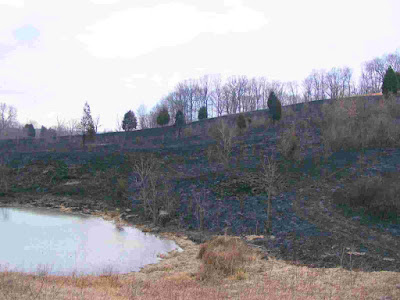
The hillsides are black today as the pictures show. But there are bright sides to all of this.

o All of the multi-flora rose bushes are very visible, as are the grape vines. This will allow us to cut many many more of them in the next few days than we would have been able to even find with all the dried grass hiding them.

o We can easy see all of the little dips and bumps that were invisible when covered with grasses and shrubs. There are lots of small places we can change the contour a bit to help encourage water to sink into the hillside rather than run down it.

o The hillsides should be beautiful when the grass and wildflowers start growing. It will be green on a black background instead of green mixed with last year's dead brown grass.

o The fire never got to our two stands of persimmon trees. I learned that for a low-wind brush fire, the narrow trails I had mowed on the hillsides served as fire stops.

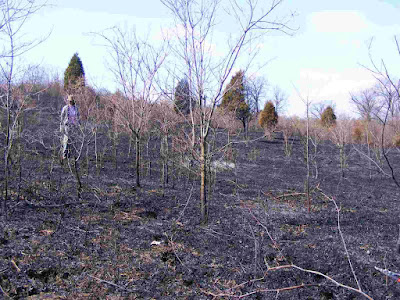
Here're the pictures so far. I'll post more soon. The gray areas in the burned sections are piles of ash.
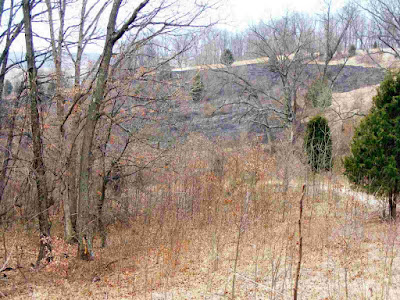
This is the view from the apartment. You can see the far hillside that was burned.


This picture and the next are taken from approximately where the house will be. The old fallen tree will be removed.
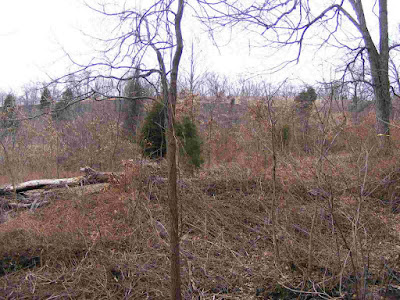


I would like to have "stitched" them together, but the service doesn't seem to be working.
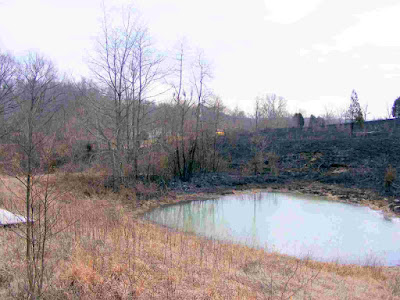


This and the next three are a view over the pond, from left to right, facing south.

Contrast these pictures with the snow scene at the top of the page.

Notice how the fire just quit before it came all the way across the dam.


Sandy is cutting vines and rosebushes among the trees that are getting started on the hillside. This area had been mowed every so often prior to our purchasing the property.
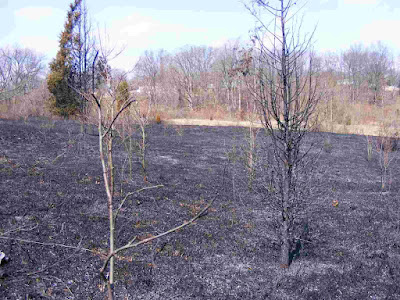


This is one of the red cedars that sort of just disappeared as the fire passed.
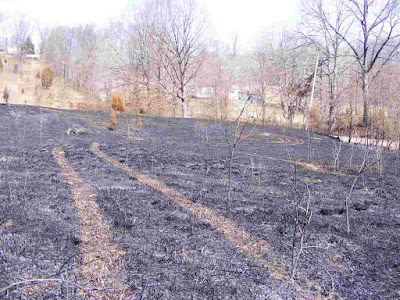


You can see the tracks of the fire departments little vehicle. Everywhere it went it flattened the ash and exposed the dried grass at the surface that didn't burn.

Wednesday, March 4, 2009

And before I forget, ...


today, March 4th, is the only day of the year that gives a command.

Corny, I know, but I learned this many, many years ago and haven't had anyone to tell it too for a long time. Plus this time I don't have to listen to any groaning.

The "falls"


Last week it rained heavily on and off for a day or two. It was still raining when I took these pictures. That explains the watery look caused by rain on the lens. I think it makes the pictures even better.

They show water flowing over the large tree root from under which the spring emerges when it hasn't been raining. The lower picture is from a bit lower. Along the length of the stream, starting at the spring, and before it levels out into a year-around damp area, there are a series of small pools. I am enlarging them a little at a time. This whole series of ponds, as well as the spring, will be visible from the west end of the house.

Usually the water flows under my little dams. After it rains, though, it just gushes over them.

A few views from last month


These pictures were taken about a month ago. I forgot I had them. They're just too pretty to spend the rest of their lives in an unseen album. Both were taken from the apartment window looking east-southeast on the same very cold morning just as the sun was coming up.


At last, visible progress


After months of investigation, discussion, drawings, more discussion, and a few decisions, we finally had some action.

A few weeks ago the county highway department began cleaning out the ditch along the county road. Then we had a string of snow falls and some really cold weather that halted the progress. Monday, while I was outside, a county dump truck stopped on the state road and backed down the driveway. It was one of the guys coming to say they would like to install our culverts the next day. The ditch was ready on our side of the road.

"Great. Go ahead," I said.

So yesterday the county installed two 18" double-walled plastic culverts. One is at the bottom of the hill where almost all of the surface water drains through as it leaves the property. We had already decided that we would not use the existing opening in the fence there for our primary access because of all the water that is often there. It's too wet and slippery for a few days after it's rained, and it would sometimes be impassible in frozen winter weather, especially with the added problem of having to climb the hill almost immediately after entering the property.

The second culvert was placed about halfway up the hill where we can come onto the property at almost the exact same altitude that we plan to place the parking area. Though the driveway will meander to get there, it will not run up- nor downhill more than a foot or so all the way across to the parking spot.

The county crew was great. They cut down some of the trees that we would have had to cut ourselves and dragged them down the road and onto the property where I can cut them for various uses. The culverts were covered with a gravel-dirt mix and limestone blocks were stacked to protect the ends from erosion. The flow down the ditch along the road can be very strong sometimes.

Here are a few pictures of the installation.


Covering the lower culvert


Removing trees at the driveway


Covering the driveway culvert


Placing limestone end wall

Hawk eye


Yesterday afternoon as I was using the laptop in the living room, something moved outside in the trees that caught my eyes. One of the hawks that usually just soars overhead took up residence in a tree outside for about an hour. I suspect he was hoping he'd have a shot at some of the birds at our feeders below the window. No luck. Yesterday, and almost every day, the birds had cleaned out the feeders by mid-afternoon, and that's after the second filling.


Sandy checked to be sure. It was a red-tailed hawk. There is a tell-tale speckled band of brown across the white breast that is visible in the picture.

Thursday, February 12, 2009

And the survey says...


A few weeks ago we surveyed, on foot, the general area of the Greene View Springs property where we hope to build our home. The remainder was also surveyed by using the surveyor's GPS equipment and downloading data at two of the four corners of the property.

The final product, since it includes more than 16 acres, was scaled at 1" = 100'. That's useful for overall site planning, but we had to blow it up quite a bit for our house-siting purpose. Here's a part of the plan at a larger scale, though I realize the scale is a relative thing when displayed on your computer screen.


This view represents about 1/6th of the total area of Greene View Springs. The large irregular polygon that surrounds the core of the plan shows the area surveyed by actual "shots" on the ground. The remainder is data from satellite surveys of the whole area. This level of information is available for the entire country.

The odd pentagon near the top represents a very large collection of large rocks that encircle an area that could be an interesting feature when we have time to exploit it. There are many rocks on the hillside. We're hoping they will be an asset and not a problem when we start to excavate.

The numbers on the numbered tree symbols each represent a size and species of tree. The two "14's", for example, are 12" popular trees; the "9" is a 30" poplar. We shot about 25 of the larger trees to help us orient the plan when we're walking around the site.

Through the middle is a "flow-line" that begins at the spring and flows to the southeast. We hope to place the house so that the spring can been seen from the west end of the building. We also hope to have a deck on the south and west sides that will overlook the stream below the spring, along the flow-line.

Though we have not determined the exact site for the house, we know where we would like it to be. Imagine a building, 60' long, more or less, running west to east from just east of the tree symbol numbered "6" and between the trees numbered "6" (above) and "14" (below).

It would be placed into the hillside with the south side just above the existing level (approx. 693') and the north side barely extending above grade in some places. The roof will start near grade at the north and rise as it runs south to allow winter sun to enter at the top of the south interior rooms.

The building may be deeper north to south in some places. If so, the deeper sections will likely protrude north into the hillside more than the rest, rather than extend to the south which would block all but midday sunlight to other south-side rooms and areas.

The view to the south from the site takes in the large hillside that is shown in the winter panorama in the blog header.

The two trees along the fence row at the county road show where we would like to bring a driveway onto the site. Cutting to the road at this point, where the grade is just a few feet above the roadway, will avoid building the driveway uphill from the wettest spot on the whole property. This will avoid a climb of about 20 feet which could become a problem in bad weather.

None of these plans are final, of course, because we haven't done any core sampling to see what's under the house site and the driveway route.