


 Posts
Posts


Thursday, September 11, 2008
Completely off topic
I was working on the blog late last night when the Late Late Show with Craig Ferguson came on the TV. If you have about 9 minutes, please listen to his monologue. It starts out pretty slow, but funny, and ends with a bang.
At the end of the show he spent another 5 3/4 minutes on a follow up.
Ferguson recently became a citizen. With humor, he made more sense, and spoke more for me, about the way we elect our president, than any news person or politician has had the courage to say.
Now I'll go back to telling you about Greene View Springs.


Overdue barn pictures
I was reminded a few days ago that I hadn't yet posted a picture of the barn after we painted it. We just got back from a CASA meeting at the courthouse and it was getting dark, but I took these anyway. Otherwise I'd probably forget them for a few more days.


North side West side
The cool hex sign was a gift from my sister Judy. Looks pretty nice, eh?
You don't see the corners because I still have to buy, paint and install them plus trim around the windows.
The trap is still working
Our cat Stubby sure likes fish skin. I never thought we'd catch anything during the day.

Autumn Olive
Here's another of the invasive species found at Greene View Springs. Some people call this Russian Olive, but that is a different variety. You can read more about the two on a page from the Pennsylvania Department of Conservation and Natural Resources, and another from the Indiana Department of Natural Resources prepared by the state's Invasive Plant Species Assessment Working Group.
Today I cut down the last of these that have been found to date. This picture shows one of them after pruning all the branches off. There is nothing left to show at all now because they have been sawed off to the ground. The two links above show Autumn Olives still standing.

Wednesday, September 10, 2008
Getting from here to there
Another ongoing project is establishing paths, or trails, around the property. It will take a long time.
I have stacked three pictures below to show how I'm doing it. They are in sequence as I came up the hill with the picture on the bottom being the lowest and the top one being the highest of the three.
First, the trail is mowed with the wheeled string trimmer. Then we cover it with cardboard. The last step is to cover the cardboard with wood chips. The top picture shows the final appearance, at least until the chips age and darken.


Each trailer load of wood chips covers about fifty feet of trail. Loading the trailer takes just a few minutes with help from Bloomfield's staff at the treatment center property. Sadly, it takes longer and longer to unload and spread the chips since each cart load from the trailer must be spread farther from the trailer and the cart pulled farther to get back to the top of the hill.
We got a nice load of cardboard yesterday so it's time to go for another trailer load.
Greene View Springs' Nessie
I've mentioned the snapping turtle that lives in our pond a few times in the past few weeks. Today I was able to get close enough without startling him to get a few shots.
The first picture shows his shell pretty well. It seems either to have some growth on it or to have accumulated some debris from the pond sticking to it. I think it is debris because it wasn't visible the last time I saw him just a week or so ago. But either way it looks bizarre, like a distorted hump.
Of course the smaller, apparently separate, part protruding from the pond is his head, obviously not separate at all.

Enlarge this second picture to get a really spooky look at one of his eyes sticking out of the water with his snout on the left. Neither picture gives a good idea of his actual size, but the shell is at least a foot long.

Monday, September 8, 2008
Shingle Oak - Quercus imbricaria
We have at least eight varieties of oak tree on the property. I think this one, the shingle oak , is the most unusual because it doesn't have the typical oak leaf shape. Click on the picture for a better look.

The books say the wood is easy to split and was once used for roofing shingles, hence the name. Its leaves are always shiny and attractive.
Tenting
Over the last few days I finished dismantling the platform we had used for tenting near the pole barn. On Saturday Sandy and I moved much of it down the hillside close to the existing pond. With three pallets as the base and three 4'X8' sheets on top, I rebuilt the platform and set up the tent.
Here's a view looking from the platform toward the pond.

Though it doesn't look like it from this angle, the tent is right next to one of the paths mowed through the property.

Grapes
Today I helped Sandy with her project of cutting out grape vines. Wild grapes are a serious problem at Greene View Springs. They cover and weigh down trees and shrubs and their seeds are spread by wildlife that eats the grapes.
We cut them off at the ground and then pull them out of the trees. Sometimes the roots are too large to cut with either pruners or lopping shears. Here's a picture of a the base of a huge vine plant that is covering three or four large trees.

The thickest of these is thicker than my forearm. Look carefully at the vine on the left and you can see it has been sawed in two.
Within a day or so we will see the vines browning out in the tops of all these trees.
Sunday, September 7, 2008
Thistle

Yes, it's an invasive, but there's no arguing it's very pretty when blooming.
If you can determine which of the dozen or so varieties this is, please post a comment.
I give up. What is that?

If you zoom in on the picture and look carefully, you can see two tiny legs forming on the largest tadpole. This is nearly the end of a long story which I'll try to relate.
Late in the spring we were entertained each night for over a week by the sound of frogs. With a little study I learned that they were tree frogs. The closest large trees to the house are about 50 feet away so we were surprised to hear the frogs coming closer to the building each night.
Next to the building, under the eaves, along with lots of plastic buckets I've been using to catch rain water, were two stock troughs, each about 4 feet long and 2 feet across. They had once been used as planters and had some holes punched in their bottoms, but I had lined them with fragments of billboard tarps and they hold water perfectly.
One day, while using some of the rainwater from a trough, I found a small frog in the folds of the tarp. The next day, believe it or not, a frog was nestled in the bracket that supports the satellite TV dish. (Satellite is the only option this far out of town. It's too hilly for antenna reception.) Since s/he was about 6 feet above ground, and the wall is HardiBoard (cement board) panels, it wasn't hard to conclude this had to be a climbing tree frog.
By now the nightly chirping was so close to the house you could tell, through the downstairs bedroom window, that a frog was within reach right under it. The next night there seemed to be two frogs close by, and soon a third, though this one sounded different.
The next morning I found a large mass of frog eggs in one of the troughs. One could already see tiny, tiny tadpoles in most of the eggs. The eggs had not been there the day before. Virtually all of them hatched, and soon we had about 500 tiny tadpoles in the trough.
I feared there wasn't enough surface area or water volume to support them all so I scooped roughly half of them into the other trough. After more studying we learned that tadpoles are vegetarians, eating only what vegetable matter they find in their water. (Some say they also east larva, but this must only be after they have nearly completed their metamorphoses, because they are sharing the tank with larva as big as they are.)
This was not good news. First, I had hoped they would eliminate the larvae sharing their space. Second, there is no vegetation in the troughs except some algae, and not much of that. Finally, with no nourishment, the troughs simply can't be expected to support them all.
Consequently, I began a program of transferring them, 50 to a hundred at a time, to the pond. I had no idea if they would survive the change, but what alternative was there? I was able to give a few dozen away to a friend with a small pond, but the rest were going to have to move.
Over the next few weeks I took almost all of them to the pond. It is a different environment: the water is usually muddy and there is at least one large snapping turtle in it, but there is also some grassy vegetation to provide cover, and plenty of vegetable matter.
The picture above is the last bucket of tadpoles to be moved. After a few months they still have not matured much in the troughs, and cooler weather is coming. If they were to make it this season, they had to move.
We hope this effort has allowed a lot more of them to grow big enough to swim away from the turtle than if they had been laid in the pond to begin with. I hope we'll hear from many of them again next spring.
By the way, I tried to find help raising the tadpoles from the Indiana Department of Natural Resources, the Indianapolis Zoo and online sources including two herpetological societies. There are plenty of pictures online, but not one had useful advice. In fact, some said "Let us know how you make out."
Here's what the pond looks like now from up the hill a bit.


Saturday, September 6, 2008
Toads
A few weeks ago, on Freecycle, a woman nearby offered a small formed pool liner. We went by to look at it and tossed it on the trailer on top of a load of wood chips we had gotten from the county recycle facility. I dug a hole for it in the swale above the driveway. Here's what it looks like in the ground. There's still some dirt to be moved to smooth it all out.

Because the hole was dug in nearly pure clay, I realized that if it rains before I got any water in it, the pond form would likely float up in whatever water seeped down the sides on the outside and accumulated under the form. You can see a gap in the surrounding soil on the right side near the middle. I shot a little water into it with a hose and sort of forgot about it. A day or so later I went up to spread some more soil and clay around the rim and found this critter.

There are two levels to the form and the sides of each are very steep so this little fellow/gal was stuck in the mud, so to speak. I added the length of 2"X4" to see if it would provide an escape.
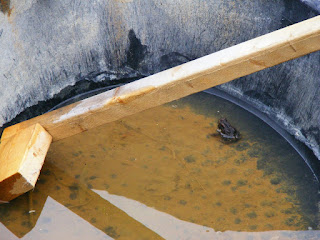
When I looked in a few fours later, the toad was gone. This won't be a problem when the pond is full, but for now I'll leave the wood ramp in there.
I find toads like this in the wildflower garden all the time. They seem to like the taller plants and I'm sure the swale has helped keep the garden moist longer after rains.

Because the hole was dug in nearly pure clay, I realized that if it rains before I got any water in it, the pond form would likely float up in whatever water seeped down the sides on the outside and accumulated under the form. You can see a gap in the surrounding soil on the right side near the middle. I shot a little water into it with a hose and sort of forgot about it. A day or so later I went up to spread some more soil and clay around the rim and found this critter.

There are two levels to the form and the sides of each are very steep so this little fellow/gal was stuck in the mud, so to speak. I added the length of 2"X4" to see if it would provide an escape.

When I looked in a few fours later, the toad was gone. This won't be a problem when the pond is full, but for now I'll leave the wood ramp in there.
I find toads like this in the wildflower garden all the time. They seem to like the taller plants and I'm sure the swale has helped keep the garden moist longer after rains.
Friday, September 5, 2008
Our roses are dying...
... and that's a good thing! ...at least in this case.
This picture shows a fairly large multiflora rose bush that is dying because of some blight that seems to be spreading. Multiflora roses are invasive, exotic shrubs. They were introduced from eastern Asia - China, Japan and Korea. In some places it is even classified as a "noxious weed."

Wikipedia has a nice picture of it blooming.
I have been cutting it off at the base, but it's hard (and sticky) work. The district forester says I should be sure to NOT clean my pruners between plants to encourage the blight to spread. It doesn't seem to affect any other plants.
I tried to take a picture of an area, about 20 feet in diameter, from which I had removed just one rose. But it's hard to show what isn't there in a picture. Next time I'll take both a before and an after shot.
This picture shows a fairly large multiflora rose bush that is dying because of some blight that seems to be spreading. Multiflora roses are invasive, exotic shrubs. They were introduced from eastern Asia - China, Japan and Korea. In some places it is even classified as a "noxious weed."

Wikipedia has a nice picture of it blooming.
I have been cutting it off at the base, but it's hard (and sticky) work. The district forester says I should be sure to NOT clean my pruners between plants to encourage the blight to spread. It doesn't seem to affect any other plants.
I tried to take a picture of an area, about 20 feet in diameter, from which I had removed just one rose. But it's hard to show what isn't there in a picture. Next time I'll take both a before and an after shot.
Thursday, September 4, 2008
Another neighbor takes a ride
Last night Sandy and I tented out to enjoy the night sounds and the cooler air. It actually rained, but not enough to completely wet the platform.
This morning I looked over to see that the trap had been sprung. Here's who I found:

I've seen bigger opossums (Didelphinae Didelphis virginiana). This one didn't weigh much either but it was as feisty as a larger one.
I don't know if opossums have been responsible for any of the pranks and destruction outside, but he or she got the same ride as the raccoons. Even if opossums haven't been trouble makers yet, I expect they will be happy to chomp down on our tomatoes and melons when they can. A quick check on the web shows their "natural" diet to be between 10 and 18 percent fruits, with the rest being a mix of almost everything you can find outside.
Subscribe to:
Posts (Atom)