Tuesday, January 25, 2011

Up On the Roof


When this old world starts getting me down
And people are just too much for me to face
I climb way up to the top of the stairs
And all my cares just drift right into space
On the roof, it's peaceful as can be
And there the world below can't bother me...

"Up On The Roof"
(Gerry Goffin and Carole King)

Finally, we have a roof. It's seemed like an eternity, but our roof is in place after two more days of moving panels, prepping them and lifting them into place, Jerry Ellis' crew has slid all the panels into place and screwed them down to the rafters. It was quite a struggle so this post might take a while...

Actually, most of the struggle was with the weather. About three inches of snow fell on us last week so we postponed the second truckload of panels until Monday. We had covered the entire roof with long sheets of plastic that ran up and down the roof slopes.

Starting yesterday, I began removing all those snow-covered plastic sheets and, of course, the snow that was on them. By the end of the workday Monday, here's what it looked like.

The plastic had been removed from the two south-sloping roofs (not shown) and the easternmost section of the north roof. There were still many snow-covered square feet to go.

The south-facing roofs' SIPs were placed by the end of the day, but I'm getting ahead of the story line.

The previous post discussed the problem we had getting the loaded truck into the driveway. In preparation for the second load, last week we shoveled the driveway, and helped by two days of on again-off again rain, most of the snow was gone. Then the driveway was covered with tarps to protect it from the predicted snow. On Sunday Sandy and I shoveled and pushed the snow off the tarps and dragged the tarps themselves off the driveway. Once it was all cleared we dragged the tarps back on because yet another snowfall was predicted.

That snow came Sunday night but was fortunately just enough to cover the tarps but not hide them. On Monday morning I dragged the tarps off the driveway again and spent a half hour or so shoveling and scraping the county road at the end of the drive.

The crane arrived and was set up at the house and we waited for the second trailer-load of SIPs. By the time it arrived the installers were also in place and we all went down to the road to see if the truck could get in. Even as the driver stopped on the road above the driveway, the truck slide a few more feet downhill. He was not very optimistic that the truck could back the trailer into the drive. It wasn't a really large truck, but a larger one, pulling a trailer, could not make the required turn.

As the driver was about to pull down the hill past the driveway so he could back it in, it occurred to me there might be a possibility he could just pull it in straight, so the drive wheels would be on gravel when the trailer came off the road. I checked with the crane operator to see how far the truck would have to get and be sure there was enough room at the end of the drive to get there.

We concluded that it might work and that it had a better probability than backing in, so we went for it. After a few tries and more than a few back-ups for aligning the trucks wheels, the truck had pulled forward enough to be reached by the crane. Success!

Next began the process of lifting the panels from the trailer onto the "lawn" area. This took longer than we'd hoped because the panels come in bundles and the bundles are mostly too heavy for the crane we had so they had to be "broken" on the trailer and the panels moved one or two at a time.

When this second load was off the trailer we took three trailer trips back to the end of the driveway to bring the rest of last week's first load up to the house. On the first two trips panels were loaded by brute force. By the third trip the panels were too low to the ground and too heavy for four of us to lift by hand, so the crane had to be moved down the driveway to load the trailer and then moved back into place to unload it onto the piles of SIPs.

Finally, a half hour past noon or so, we were ready to start lifting panels. So we took a lunch break. ?!

Here you can see the stack of panels, one in the air and the crew on the roof awaiting it. This panel went on the top of the third bedroom.

The panel on top to the right is just sitting there waiting its turn.

The holes that can be seen in the sides of some of the panels on the pile are where the nozzle is inserted to pump in the insulation. Between each hole is a thin black line that shows where the segment dividers are. There is a small number at each hole that tells the machine operator how many seconds to leave the nozzle in for that particular segment. Pretty slick, eh?

The two south-side roofs were completed on Monday.

Today the large roof that slopes down to the north was completely installed. This shot shows the progress about half way across the building from east to west. The thin panels can be seen awaiting their turn to be covered. They look pretty uneven at this point, and they are, but they will be tacked up onto the bottom of the SIPs with small brads to get them smoothed up.

And here's what they look like from the inside. Notice that some parts of the ceiling are not covered with the thin panels. These are areas that will have "normal" ceilings - the bathrooms and the utility room.

This view shows the second bedroom above and the larger bathroom to the right. There will be a wall between them of course.

And finally, here's a view from an angle that hasn't been shown in any previous posting, looking through the trees to the east of the house. The panel in the air is the last one to be installed. A few minutes later the roof was all in place.

The crew took about an hour to finish screwing down the SIPs, nailing down tongue edges where panels fit into groves in adjacent ones, and filling holes with insulating foam. (At least one hole and sometimes two are drilled into each panel to hook them up to the lifting cable.)

Finally the ball is entirely in our court. Much is left to be done, but it can now all be done on our schedule. Doors and windows will be delivered on Thursday.

Saturday, January 15, 2011

Not quite what we'd hoped for


Friday was to be the big day - the day our SIP walls and roofs were to be installed. It started out fine: The crane arrived and the operator set it up right near the building; the trucker called to say he was loaded up with panels and on his way, and the installers arrived and unloaded their equipment. We all waited for the truck to arrive.

On Wednesday and Thursday Sandy and I had begun placing the paneling that will hide the bottoms of the roof SIPs. (Think of them as really thick wall paper.) We couldn't start earlier due to nearly two days of snow, much of it still covering our entry road. There were still a lot of panels to put up and we hoped we could get them done fast enough to keep ahead of the SIP installation.

Soon the truck and trailer arrived on the county road, went just past our drive and began to back uphill into the driveway. He was unable to get enough traction to get started into the driveway. Then he drove south to the end of the road and turned around, hoping that, by heading uphill, backing into the drive would be possible.

To make a long story short, after a few slippery tries back and forth, we ended up with the rig cross-ways on and completely blocking the county road and unable to move either way without slipping all the way into the ditches on BOTH sides of the road simultaneously!

Eventually a wrecker was called to pull the rig uphill and open the road. In the mean time, the crane was relocated to the end of the driveway, just off the road, and all the panels were picked up and moved onto the small parking area there. Then the panels that could both fit and be lifted manually were loaded onto the crane and driven to the house.

The last three wall panels were too large to move on the crane so they are still waiting near the road under a tarp with a half dozen of the roof panels until the driveway can be maneuvered by the truck and trailer. (Our plan is to break up the snow and ice, cover the driveway with tarps and hope the sun will melt it dry under the tarps.)

The rest of the day was spent mounting the wall panels that were moved up to the house. Here's a view of the crew installing the short wall behind the office space.


While the installers worked on the SIPs, and with the help of our grandson Nicholas, I continued placing and tacking the panels into place.


The only upside of the truck-on-the-slippery-driveway fiasco was that we were no longer under extreme time pressure to get all the under-the-SIPs panels in place. Obviously the truck did not go back for the second load so the roof would not be finished this week.

We finished the roof paneling installation Saturday and began covering the panels with plastic in expectation of the snow and rain predicted for next week. Our installers cannot come back until at least Thursday, and more snow is predicted for that day, too, so we don't know when the job will be done. Thursday is the soonest possible, and only if the driveway is not frozen and we can get a trailer in to the house.

With most of the exterior walls now in place, after getting all the plastic up tomorrow, and if there isn't enough wind to whip off the plastic, I'm hoping to get some interior work started.

Bye for now.

Thursday, January 6, 2011

Bummer!

For about a month, the installation of our SIP panels was scheduled for this Friday and Saturday, the 7th and 8th of January. Last week I called the installers to verify that we were still on for those dates and got a "Yes."

I then called the manufacturer to assure them the SIP panels would be picked up on the 7th, the truckers to verify we were still on their schedule, and the crane company to be sure we could unload and lift the panels into place. Everyone was on the same page.

My plan was to use this week to remove the tarps and put up the paneling that will show above the rafters and under the SIPs. (See post showing panelling.) The weather forcast was good - either clear, or well below freezing, so any precipitation would be snow, not rain.

Monday morning we got a call saying the installers could not be here this week and they had to put us off until the 14th and 15th!

What could we do? Nothing! Too late to schedule anyone else, if there even is anyone else nearby with the experience (and availability) to install the SIPs. I called the other three participants in the venture - manufacturer, trucker and crane operator - and verified that a week later would work for their schedules. Fortunately they all said it would.

So, instead of getting ready for the SIPs this week, I am using the week to remove the tarps and spread them on the ground so they might warm up a tad and be more supple when they are replaced over the SIPs next weekend. Next, after the projected snow showers today and tomorrow are over, I'll start lifting and fastening the panels and hope for the best (no rain, but not too far below freezing) for the rest of next week before the panels go up.

I'll post a picture when all the panelling is in place.

Wednesday, December 8, 2010

Cold but clear


It was very cold last night, and a snow storm is predicted for this coming weekend, but this morning the frost on the grasses and trees was very pretty. I took this picture on the way to the mailbox.


We still haven't gotten a delivery date for our SIP's walls and roof. It's looking like an installation before Christmas is not going to happen. If not, it will be pushed back to the week after New Years Day.

Tuesday, November 30, 2010

Waiting on our SIPs


Our order is in for production of our SIP panels for the remaining walls and roofs. The view below shows the east wall framing that will be inside the SIP wall. Drywall will be inside this framework. This will make the east wall of the kitchen a full 10 inches thick, though the space between SIPs and drywall will not likely be heavily insulated since the SIP provides R24 insulation on its own.

Under the wire


I was reminded on Saturday that I hadn't yet made a single entry in the blog in November. We have been busy, and lots has been done, but it isn't always clear what others might find interesting.

A contractor for our electric utility has been trimming trees along the power lines. They hadn't been trimmed on our property for years before we bought it. It was needed badly and they did a thorough job. All in all they didn't hack up our trees too badly.

The upside for us was about six truckloads of wood chips dumped where we asked for them. Sandy took on the project of moving them to where they were needed.

The pile of chips on the right above is about a tenth the size it was when Sandy started. Much of the chips was spread on the hill in front of the house.

Much, much more was spread on the leach field, probably over one hundred cartloads.

And yesterday, before it turned cold and nasty like it is now, she organized a final assault on the open soil above the house with cart and buckets that took about three hours, but got the whole area covered.

In the first picture you can see the progress made on the south walls. They are all framed and mostly covered with house wrap. The next post will show the east end of the house.

Sunday, October 31, 2010

Spooky night


Well it's Halloween and I just got done working. I've been trying to get a wall done each day. Two to go, but together they have two doors and three windows which take longer to frame.

Here's what it looked like at the site about 9:15.

Thursday, October 28, 2010

What a wind storm


Much of the Midwest experienced a major storm Monday, and we were no exception. The entire new house had been covered with billboard tarps for weeks but they had hardly been necessary. We have had some record-setting low precipitation months this summer and the soil is as hard as a rock.

A few weeks ago we bought some chrysanthemums at the auction. When we tried to plant them the next day I was unable to make a hole in the soil near the road, even using a pick ax. Instead we built a very small pool for them, watered them well and will plant them after the soil softens up. They should look great at the entry, next year.

Here are two shots of the building with missing tarps. It was cold today, and will be until midday tomorrow, but after that I'll get the rest of the tarps replaced. As shown in the second pictures, I'm now nailing long boards to hold them down so I don't lose another day replacing them.


Sandy's sanding project


After installing most of the old rafters from the 140-year-old barn, we decided they were just too grungy and Sandy took on the task of sanding them clean.

Here's an example of how they looked:


She worked on them for about a week, at least a few hours each weekday and some on the weekends. Our oscillating sander lost its pad, and though we tried to glue it back on, the connection only lasted an hour or so before it came off again.

She found a light belt sander and finished the job with it. It was worth the effort as you can see by this picture:


In other news, we've ordered our SIP roof and walls about ten days ago, and our windows about a week before that.

Thursday, September 30, 2010

Why a green roof?


As I was researching various aspects of our earthen roof-to-be, I came across "In Support of the Earth Roof", a brief article explaining the merits of what we are doing. I thought those following our progress might find it informative.

http://www.chelseagreen.com/content/in-support-of-the-earth-roof/

It's a team effort


Though I have been doing the bulk of the work on the new place, Sandy has been doing more than a fair share altogether. She keeps the apartment together, feeds us, and then comes down to the site and works there, too!

One day she's moving earth up above the building ...

The next day she's sanding rafters that didn't get cleaned before they were put up ...


Where will she be found next?

The end (of the rafter project)


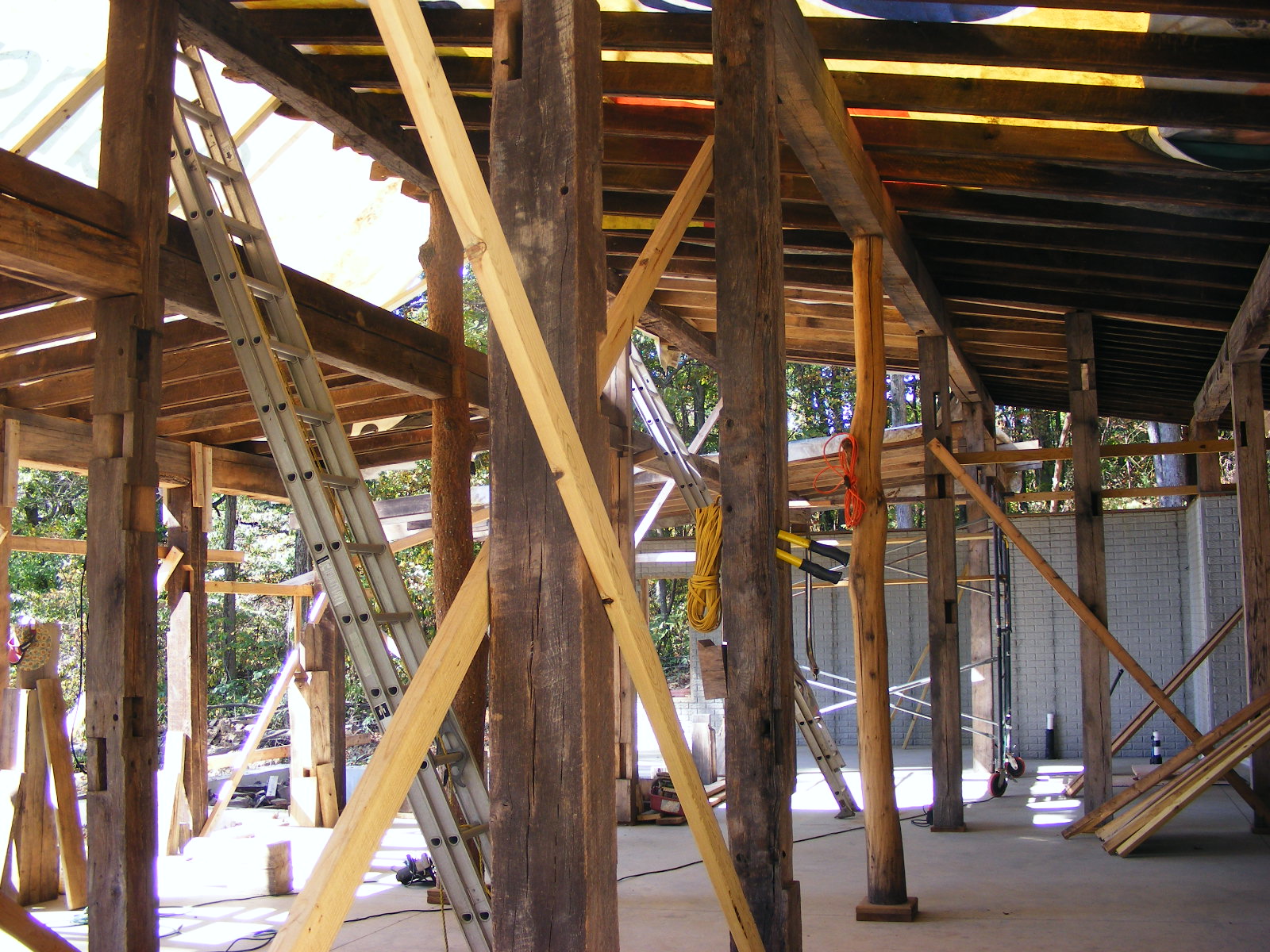
It seems like forever since I started putting up rafters, but by the end of last week the task was complete. I didn't work on them every single day, but it seemed like it.

By the time I got to the last of the three rooms which will have a drywall ceiling and not be visible I was using shorter pieces of 2 X 6's, screwed onto longer pieces, and butted together on top of beams. I did not have enough to complete the west-side bedroom so I used 2 X 8's for that room. We have plenty of 2 X 8's left over and I hope to use some of them for a feature on the outside east wall.

All of the rafters are now covered with billboard tarps so they are a bit harder to see in the pictures below.


Don't worry, the posts in the picture above are not bent though they appear to be. It's a distortion due to the shorter distance from the camera to those two posts than to the others. The whole tree posts in the top picture do have slight bends in them.

Friday, August 13, 2010

The rafter project


It took two full days, with the help and trailer of my friend Steve Bonney, to move the 140-year-old rafters from the barn we took down from their storage site to the new house. There are enough to cover all the common areas - living room, kitchen and hallway. The bedroom rafters will either be purchased lumber or come from the stacks that came from milling timbers a few years ago. Of course they are also at the storage site, too, so, either way, more work will be involved to get them here.

Our engineer calculated that the old rafters could be used but they would have to be spaced 12 inches apart. I put a half dozen or so onto the front roof beams. It looked terrible. One foot apart was just too close together. It was hard to see any ceiling at all at that spacing. (The rafters in other rooms will be covered with drywall and not be visible.)

After checking with the engineer, we determined I could place rafters together in pairs at two-foot intervals and still be safe. To make them stronger I am screwing them together every 12 inches or so. I think they look pretty good in pairs.


On top of the rafters and under the SIPs we have decided to use paneling that looks better than the OSB panels used to make the SIPs. The picture shows what they will look like.

Two panels are just sitting on the rafters for the moment. You can also see shims that were used to make all the old rafters the same height. These will be trimmed off later.

Dragging the rafters up, cutting their ends even, aligning them, screwing them together, shimming them to a common height and finally screwing them to the beams, is a very tedious and time-consuming procedure. The final steps are attaching the high ends to planks that run crosswise to hold them in place, and separating the low ends with short sections of lumber to strengthen them. Also, since we will not have an attic, these short pieces are part of the material that will insulate along the tops of the outer walls.

Oh, did I mention it's so darn hot I can only work from about 8 AM until about noon each day. Heat indexes for the last week have been over 100 degrees almost every day. It's been two weeks since we've had more than a trace of rain.

Wednesday, July 21, 2010

Filling behind the walls


We also finally got the earth backfilled behind the concrete walls. Although a lot of hand shoveling and raking is still needed, you can see how the north side of the building now looks. It will be very easy to get onto the roof, eh?


Around the two windows in the concrete walls I hope to build some retaining walls from the rocks we uncovered during excavation. They should make nice little rock gardens just outside the windows. Here's my first try at it.


Above the wall on the west side I've scraped some small swales to encourage run-off away from the building. After a series of rainy days, it all seems to be working and the wall is holding up.

Lucas digs our septic drain field


The week after the Fourth of July, one of my sons, Ed III, came for a few days with his kids who live in Germany. Lucky for me, because I needed help installing the septic system and it appears Lucas has some skills we didn't know about. After helping drag some trees out of the area, Lucas asked if he could get into the trench. Ta Da!


That was fun enough, but the next thing I knew he was driving the bull dozer with the help of Scott Schroyer of Hash Farms Excavating.


To the right in the picture below you can see how thick the young woods were where the drain field was installed. Literally hundreds of small trees were cut down. I hope to use most of them in various ways, as archways, railings, wattle fences, plant supports, etc.


Initially we had planned to install a system that needed only two 70-foot runs, just a few feet from each other. Before the job started we realized there was not enough room to put in the line with the extra space needed for a perimeter drain as required. It would have run too far south where the terrain drops off quickly, way past the dozer shown above.

A request to install instead three 50-foot runs was denied. No reason was given, so we fell back to a "traditional" drain field. It was less expensive, but as you'll see it ate up an enormous amount of space - about twice what would have been used otherwise. In all we would dig up five 50-foot fingers spaced 8 feet apart and ten more feet on the west and north for a curtain drain.


Further, as the project proceeded we realized the drop-off east of the third finger was also too severe. To deal with this issue the other two fingers were angled to the east, across the trail near the hydrant. This wiped out the last buffer area to the west of that trail. The resulting open space is huge, but the deed is done and the system is ready to use.